


Arboga Hydraulik was founded in 2012 when the company where they had worked for many years decided to close its Arboga office. In consultation with potential customers, Mikael Andersson, Stefan Johansson and two former co-owners decided to start their own business.
– Since then things have gone well, and we work almost exclusively with customised hydraulic systems as well as installation, service and spare parts sales. Since the 1980s, we have worked with hydraulics for the workshop, vehicle and power generation industries, but also for the defence sector, says Mikael Andersson at Arboga Hydraulik, responsible for sales, engineering, planning, hydraulic design and installation.
A developed structure for assessing risk
One of the company’s business areas is offering risk analyses at customer sites.
– When we design our own systems, we follow an established protocol for carrying out a structured risk assessment before deciding on design and execution. We use the same protocol with customers, often adapted to their specific conditions, explains Stefan Johansson, responsible for purchasing, warehouse, marketing, administration, IT and mechanical design.
In their own manufacture of hydraulic parts and systems, they work with safety from several perspectives, including CE marking requirements.
– For complete systems, we ourselves are responsible for the CE marking, with everything that this implies, and if we sell parts for a system, we provide a declaration for incorporation of partly completed machinery. In that latter case, the customer is responsible for the final CE marking.
Customers still want documentation on paper
Their customers are mainly in mining, automotive, aviation and hydropower. They also install central hydraulic systems that distribute oil flow to various equipment, including control systems and piping systems.
– An important part of structured safety work is always to include relevant documentation, and that often becomes very extensive since everything must be documented, both large and small, Stefan Johansson says.
They themselves work extensively with computers and store all information on their own server.
– We avoid putting things in the cloud for security reasons. We have our own system that is checked from a security perspective by an external company, so everything is secured.
But even though they store everything digitally, customers often still want documentation in paper form in folders that make troubleshooting on site easier.
– We offer digital documentation via DVD, USB or encrypted cloud services, all depending on the customer’s wishes. Some customers no longer have the possibility to read CD/DVD media, and others regard USB as a security risk.
Based on the Machinery Directive
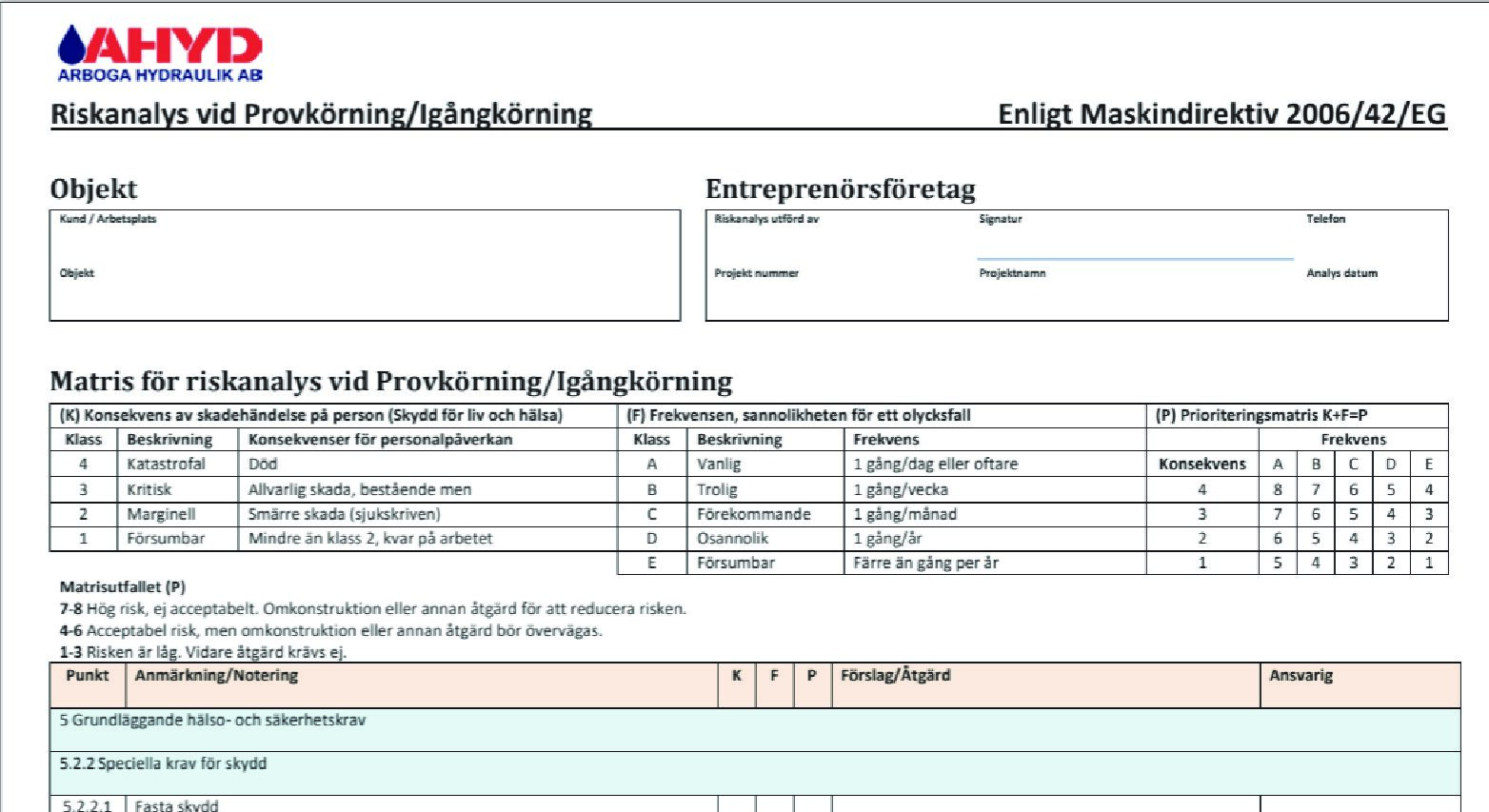
When they conduct risk assessments, they start from what is required in the Machinery Directive and have developed their own structure for the assessments from that.
– It is based on a kind of coordinate system with different levels of risks and consequences. It becomes a scoring assessment built on the probabilities of different outcomes. On the front page of a risk assessment, one evaluates, among other things, the consequences of a risk from minimum to catastrophic, where the latter means death.
Lack of marking is common
When designing completed machines, the entire risk assessment should be carried out with regard to where and how the machine will be used.
– For example, if the machine will stand in an area where people move around, you may need to protect the hoses, and if there is a hot surface, a curtain should be hung around that area. These are often relatively simple measures that make the workplace safer, Mikael Andersson explains.
They also help to conduct risk assessments on existing machines and equipment at customer sites.
– A common fault we see when visiting customers is that pipelines lack marking. According to AFS 2002:1, there must be marking stating both what flows in the line and in which direction it flows. Sometimes there is no marking at all, says Stefan Johansson.
Arboga Hydraulik marks hydraulic pipes during installation, usually with tape with a black background and white text indicating hydraulic oil that does not ignite below 100 degrees. It is also important to include arrows showing the direction of flow. If an emergency action has to be carried out and a line may need to be opened, that knowledge is essential.
Documentation is often missing
Many of their jobs are carried out in the hydropower industry, both with hydraulics for dam gates and turbines.
– When we are on site at a customer, we make a risk assessment and suggest what needs to be corrected. It may involve information on emergency control of a dam gate if needed. Emergency actions must be possible for anyone to carry out; special knowledge should not be required. In such cases, an instruction is prepared and mounted near the control, showing step by step what to do.
When it comes to safety, they make sure that the customer receives complete documentation for installed equipment, so that if needed they can hire another supplier who, using the documentation, can carry out work safely.
– In many of our service jobs at customer sites, current documentation is missing, which means that an analysis of the object we are asked about must be carried out on site.
Creates eye-opening moments
When conducting risk assessments at customer sites, the customer often gets eye-opening insights, both expected and unexpected.
– On one occasion, a customer realised how large the pressures inside a hydraulic tank can become. We showed them how their rectangular tank had almost become round from overpressure and explained what danger that represented. They then had the tank rebuilt and introduced a safety system against overfilling. If the person filling the tank does not get information from the primary sensor that the tank is full, the oil overflows into another vessel with its own sensor that triggers an alarm, Mikael Andersson explains.
Arboga Hydraulik also recommends that pressed emergency stops in a central hydraulic installation should be addressed, so that one can immediately see which emergency stop has been activated and take appropriate measures.
– In those cases, the responsible flow manager and facility have received a phone message indicating where an accident has occurred.
Different types of risks
At another customer site, they identified a completely different type of risk, more related to employee wellbeing.
– It turned out that the pistons in the hydraulic pump created vibrations that spread from the factory floor to the open-plan office above. In that office, some staff had for a long time been feeling unwell, with nausea and headaches. This could be remedied by installing a TPD in connection with the pump.
Once they have carried out a risk assessment at a customer site, they compile a report and hand it over to the customer.
– It includes risks that can lead to personal injury, production downtime and/or damage to property. One example of a risk leading to production downtime that many people do not think about is that a system may contain components that are no longer manufactured. We then ask the customer whether they have a spare part on the shelf, which they rarely do. Our advice is to consider rebuilding with equivalent and easily available components.
Must-should-could measures
When the customer has received the risk assessment report, they decide which parts they want to address immediately and which they will postpone.
– We divide our recommendations into those that must be dealt with, those that should be dealt with and those that could be dealt with. The ones we classify as musts are usually carried out immediately, since they often concern things that can lead to personal injury. Other things they may choose to wait with.
With the report in hand, the customer can then turn to whomever they want; they are not tied to Arboga Hydraulik for the corrective actions.
– Usually they come back to us, but that is absolutely not a requirement.


