


When Fluid Scandinavia last had electrification as its theme, four years ago, we spoke with Paul Bogatir, cluster manager for HHK. At that time, his main message was that the hydraulics industry must dare to lead development rather than simply follow others. We spoke with him again for this issue to hear how he thinks things have progressed, and he does not believe the industry has yet taken on that leadership role.
– Electrification is such a major transformation for society as a whole that we need to start thinking differently. Sweden is in a risky position if we do not make sure we are at the forefront of that development. China is far ahead and is on its way to pulling away, at least in electrification.
At the same time, he views what the hydraulics companies in Hudiksvall have achieved since then positively.
– We have managed to create an internal culture in which companies dare to think in entirely new ways and support each other in developing innovations. A collective mindset is important, and so is daring to leave the comfort zone and take risks. It is safer to take risks together with others. It is easier to navigate the unknown together, Paul Bogatir explains.
The rulebook is being written now
He goes on to note that, because electrification is still a relatively new field, there are not yet any fixed rules for how different problems should be solved.
– We are the ones writing the rulebook now, and if it is to become a good framework, we need to bring in several perspectives. You have to assume that your own perspective is not enough.
He also sees other circumstances that have changed the situation for Swedish companies in just the past few years.
– With so many new uncertainties in the world around us, war, high tariffs and other factors, companies need to think in new ways to find the right direction. The transition to a fossil-free world is also so broad that it is not enough for industry alone to do the right thing. Cooperation between many different sectors is required if the transition is to become reality.
Need to reach further
Within HHK, they realised years ago that if companies are to contribute to a fossil-free society, they need to find new ways to reach the market.
– We need to help move the whole of society in the same direction, and over the past few years we have been thinking about how we can get innovations in electrification out on a large enough scale to make a real difference. To move a country like Sweden, decisions are needed at several different levels.
They know they have created something special within HHK, but to create real system solutions they need to include much larger and broader parts of society.
– We need to involve municipalities and regions more so that they can begin procuring sustainably. Political decisions must start to align with what companies are doing, so that industry’s major investments in sustainable technology can make a difference. We need to connect everything so that what we have done within HHK can actually influence society.
EVDArena
One result of these reflections on how to reach more broadly is that they have now created EVDArena, Electrification Value Discovery Arena.
– The platform is meant to take a helicopter perspective and focus on how a major transition in society can be achieved. We have actors from five different sectors – industry, the public sector, academia, civil society and environmental actors. All of those sectors need to work together if we are to see a real and visible transition.
Civil society is a very important part because it can put pressure on politicians, whose decisions govern procurement and create demand for new technology.
– One example could be residents in Hudiksvall asking why snow removal is not fossil-free. It does not need to be more complicated than that. That can lead to discussion and to new political decisions that move society forward step by step. And when we learn how to move Hudiksvall in the right direction, we can continue with larger cities.
Showing the value of electrification
The need for hydraulics companies to lead the way, and help drive the transition by doing so, is partly linked to the fact that hydraulic work machines are used in many parts of the building of society.
– That is why it is important for civil society to understand the value of the hard work hydraulics companies are putting into electrification, and for us to reach people and show the difference we are making. I also think Hudiksvall is a good place to begin when looking for ways to reach further. Hudiksvall is like a microcosm – decision paths are very short, companies have come a long way in development, and there is already an established collaboration. EVDArena’s work is to take these lessons from Hudiksvall and spread them further through the regions.
He also explains that it is important to identify shared areas of focus where several parts of society can see clear benefits from electrification.
– If we can find those kinds of areas, the likelihood that the transition will actually happen becomes much greater. To identify them, we will gather leading actors in the northern industrial belt and map out a strategy for how the whole region can benefit from electrification. We need to help other parts of society understand the value of having active companies in the region that contribute with jobs and with the development of other companies. The question in such a gathering becomes how we can create relevant value in society from companies’ innovations.
Understanding each other’s perspectives
An important part of such a strategy is finding ways for different sectors to understand each other’s perspectives.
– We can move forward faster if, for example, politicians understand the logic of companies, that quarterly reports govern many decisions, while companies understand that politicians work in election cycles and that decisions are influenced by what voters demand.
Since HHK has been built largely around innovation development and daring to think outside the box, that working method will also apply within the new EVDArena.
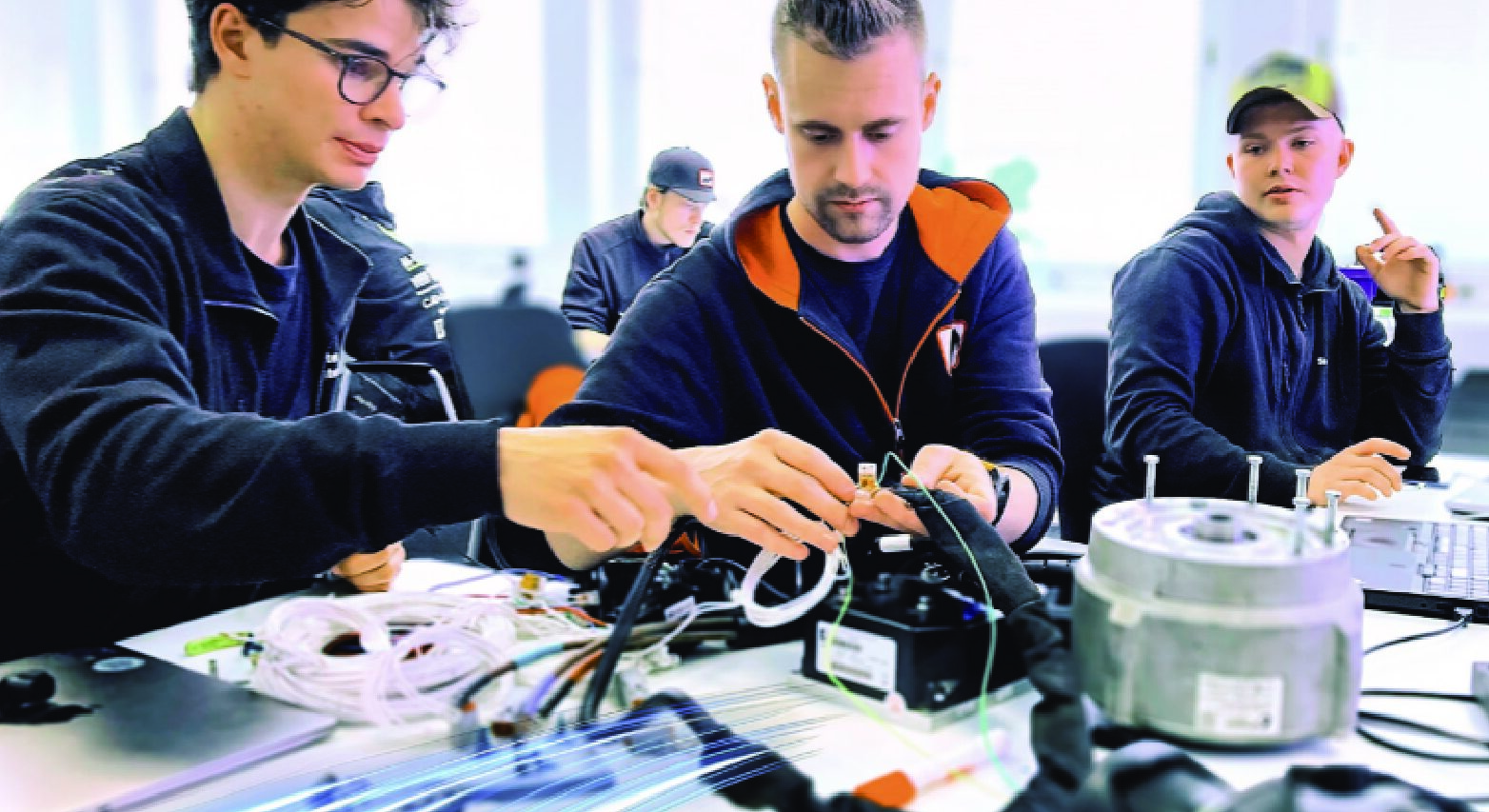
– Because EVDArena is larger than HHK, we can include more actors and stakeholders and in that way also find new ways of reaching civil society. One project we have been working on for a year is that we gave an assignment to a student association, M-verkstan, at Linköping University, with which HHK already has an established collaboration. M-verkstan has been given free rein to build an electrified hydraulic vehicle that will help civil society in Hudiksvall understand the value of electrification. The only limitations are that the vehicle must be easy to communicate about and fun enough to attract attention.
That vehicle is now almost finished and will be launched soon.
– The idea is that the vehicle should, in an illustrative way, show both what hydraulics is and the value of electrification. We hope it will attract a great deal of attention, which in turn will lead to an engaged discussion in the city and help connect the goals of several sectors in continuing to drive the transition forward.
Need to dare to lead
What he would particularly like to see brought into that discussion is that more advantages of electrification are highlighted.
– I think the discussion in society about the transition to a more fossil-free future has become misguided, especially when we see the latest COP meeting and the controversy around removing the ambition to phase out fossil fuels. The focus is too much on reduced carbon emissions, but I think we need to speak more broadly. Many people have difficulty seeing the everyday value of lower carbon emissions, but they can understand the value of lower emissions from vehicles so they do not have to breathe in harmful substances on their way to work. Another advantage worth highlighting is that electrification means much quieter vehicles, less operator fatigue and a better working environment.
He ends the conversation by once again stressing how important it is that all the positive developments taking place in industry, which can contribute to the transition, reach further out in society if they are to have a real effect.
– I also want to point clearly to the threat from China and other markets. Here in Sweden, we cannot continue hesitating and waiting to see what others do. If we do, we will inevitably lose competitiveness. We have to dare to lead.


