


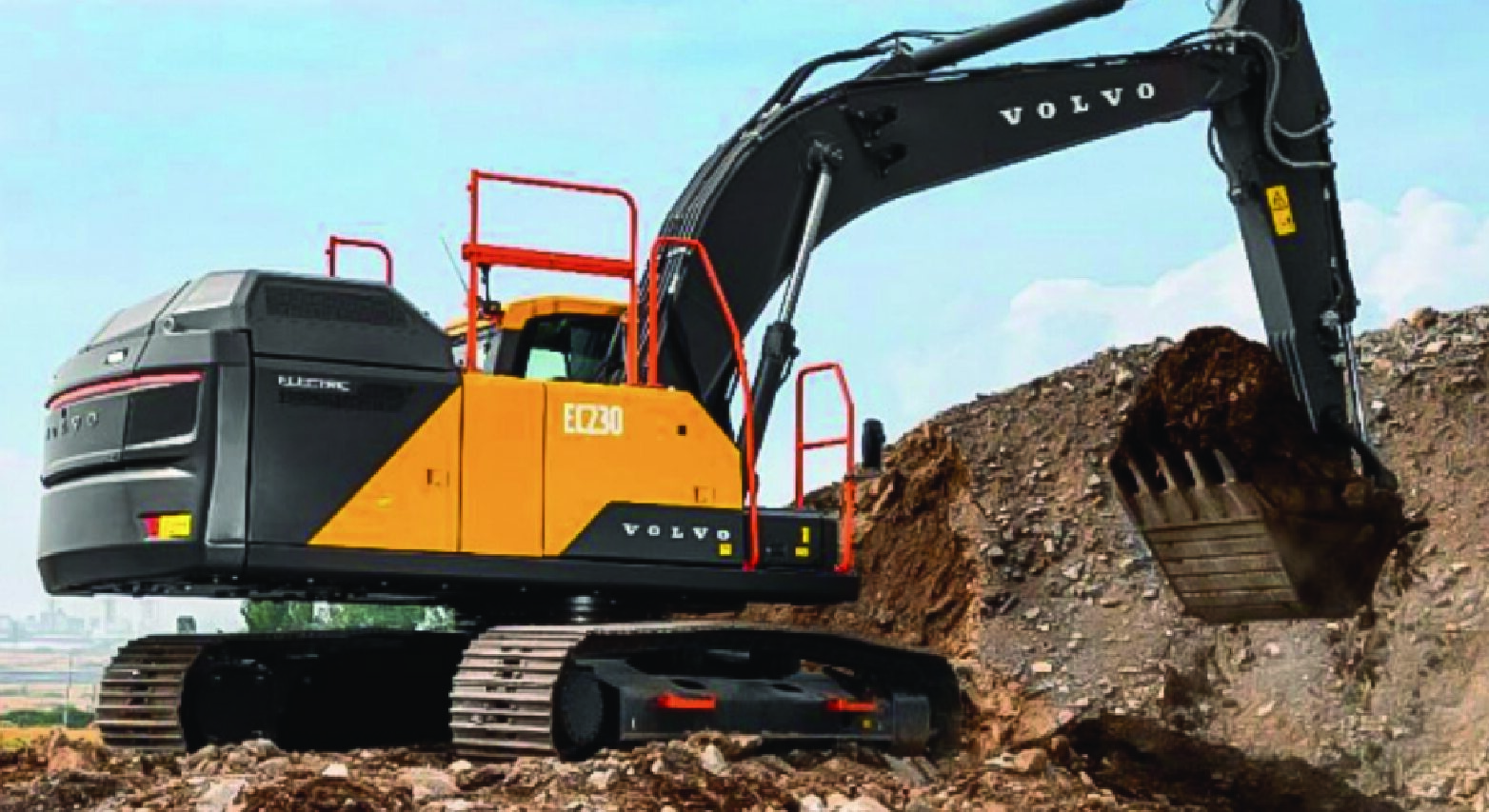
Volvo CE has set an ambitious goal of becoming completely fossil-free by 2040. Mats Sköldberg is CTO at Volvo CE and says the company has strong reasons to push ahead with electrifying its construction machines.
– One reason is that we want to contribute to reduced CO2 emissions. Even though we are part of the emissions problem, we want to be part of the solution. The other reason is that global competition from Asia, especially China, is increasing all the time, and we need to keep up and, if possible, regain a leading position, he explains.
The company has worked on electrification for a long time and already has several smaller and medium-sized construction machines, such as excavators and dumpers, that run entirely on electricity.
– We also have larger machines powered by electricity through cable connection. They work well where that type of power supply is available.
Adapting to electric operation is necessary
When construction machines are electrified, the whole system needs to be adapted. It is not simply a matter of changing the engine from diesel to electric.
– Especially for large excavators, the whole system needs to be adapted. The hydraulic system needs to become more energy-efficient and also be able to recover energy in certain moments. For example, we have a smaller excavator, our first battery-driven one, that recovers energy in the hydraulic system when the lifting arm moves.
To meet the challenge of fully electric large excavators, the battery side still needs further development, but development is moving quickly towards better and cheaper batteries.
– So far, it has been easier to develop battery-powered wheel loaders, since they can more easily drive to a charging station. For large excavators, there is still a difficult balance between including enough battery capacity and at the same time achieving the right price level for the customer. It still has to be profitable for them.
Volvo CE has worked for a long time on adapting hydraulic systems to function better with electric motors.
– We have a close collaboration with Linköping University and its hydraulics research. The challenge is getting results from our collaborative projects to mature and become ready for the market. We work under high time pressure and put a great deal of effort into shortening time to market.
Charging infrastructure needs to improve
Another challenge Mats Sköldberg points to when it comes to getting more construction machines to use electricity instead of fossil-fuel engines is the charging infrastructure.
– We see a clear link between places where the infrastructure works and places where a lot is happening in electrification. To speed up the transition, the infrastructure therefore needs to be strengthened broadly across the country.
To contribute to that, Volvo CE works closely with both charging suppliers and electricity distributors.
– We also work a great deal with authorities and run various pilot projects. Cooperation between many different actors is essential if we are to succeed in electrifying at the pace we need, he says.
Need to meet the competition from China
It is clear that Sweden and the EU need to accelerate electrification when you see how quickly things are moving in Asia and China, especially in the vehicle sector.
– It is both good and bad, but they absolutely make sure that global development is moving forward quickly, which we can also benefit from. For us in the EU, it means that we need to place higher demands on ourselves to, for example, improve hydraulic efficiency faster and more extensively. It is clearly a very good time for innovation when competition is intensifying.
China is also showing that production can be much faster and more cost-effective, which is something the EU needs to respond to.
– We need to reduce time to market in order to keep pace. It is a matter of identifying what needs to be done and then setting clear goals and carrying them out. I think Volvo CE is in a relatively good position, but there is always more that can be done, Mats Sköldberg concludes.
Great opportunities for hydraulics
When asked what he thinks the hydraulics industry in Sweden needs to keep in mind in order to keep up with electrification and tougher competition, he points to the importance of hydraulics.
– There are enormous opportunities to adapt and improve hydraulic systems in connection with electrification; it is simply a matter of realising them. For linear movements, hydraulics will remain strong in the future. We just need to seize the opportunities to improve it and in that way help electrification progress faster and better.
Cooperation on standardising electrical equipment
In a joint effort to accelerate the development and availability of emission-free solutions in Europe, Volvo CE has joined a broad group of electric pioneers to establish a new roundtable on open market standards.
The OEM roundtables have been arranged by the ENI foundation, Emissionfree Network Infrastructure, and the smart charging association ElaadNL, bringing together actors from the entire value chain for construction equipment.
The rollout of emission-free construction equipment is progressing at different speeds in different European markets. The roundtables will therefore support the establishment of open standards before production scales up in regions where electrification is still in its early stages. A typical example of standardisation would be creating the same smart charging protocol for different brands and machines – something Volvo CE pioneered in 2023 with its 48-volt charging protocol. By distributing such protocols more uniformly across suppliers of construction machines, it will become even easier for customers to switch to electric power.


