


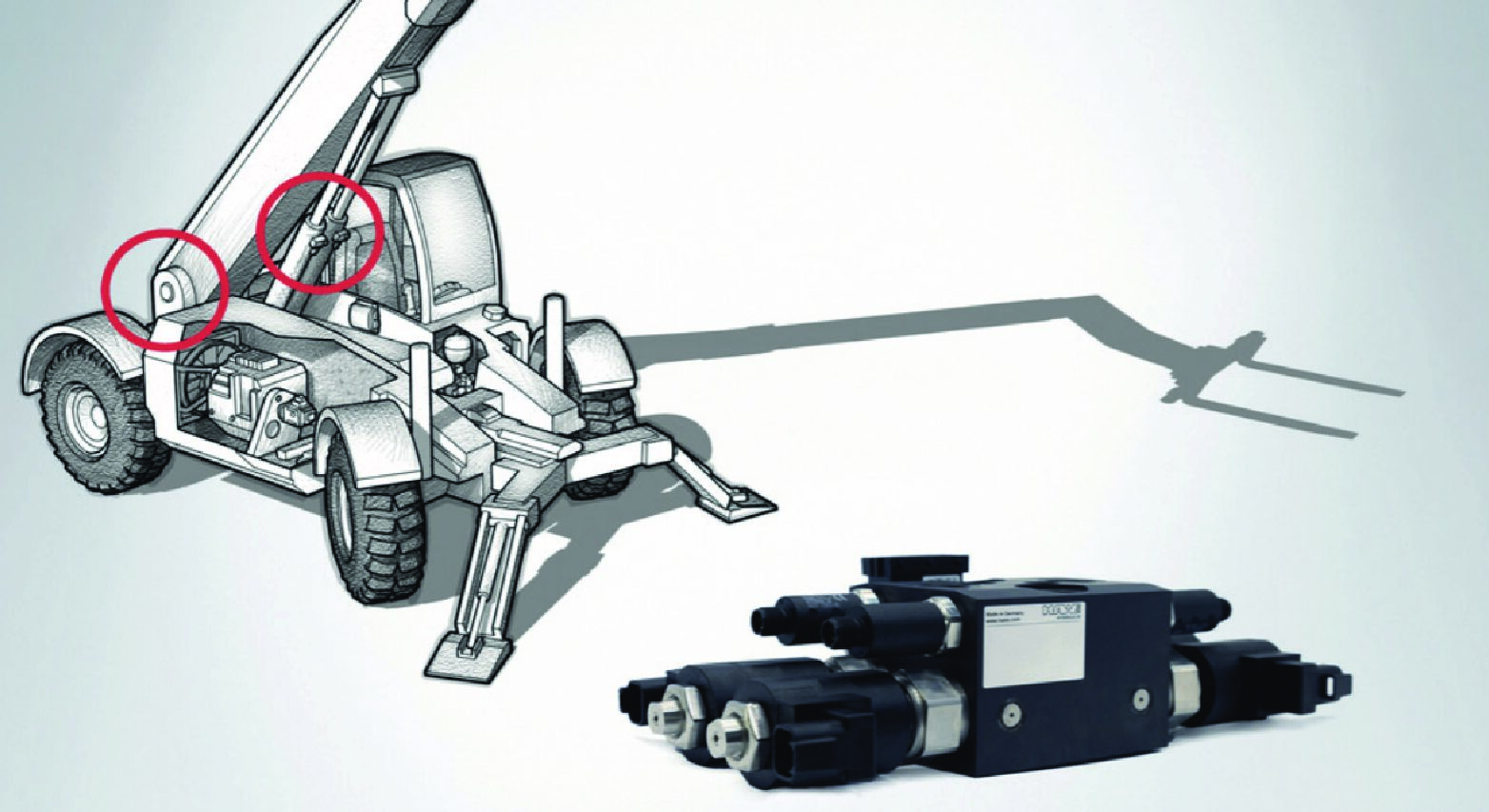
This is explained by Andrea Farris, Key Market Manager, and Mikael Palmqvist, technical sales representative at HAWE. They say growing market demands for higher efficiency and productivity require development that goes beyond classical mechanics. In the new VIPR valve unit, machine learning is used where the potential lies in combining mechanics with data intelligence.
Independent Metering offers many possibilities in combination with different control functions. The hydraulic system becomes simpler because fewer components are needed, and load-holding valves and pilot-operated check valves can often be avoided. At the same time, the system becomes more advanced because it requires more sensors and electronics. VIPR combines four identical proportional valves for individual control, and with integrated pressure sensors it becomes possible to monitor and control the functions to and from the consumer.
Developments in electrical networks are also placing new demands on hydraulics. HAWE points to the need for flexible solutions and modular thinking that can be adapted individually for each machine and function without requiring huge new design resources. The aim is higher energy efficiency with maintained performance, as well as easier commissioning and maintenance even when more sensors and connected components are integrated into the system.
One reason why such a promising technology has not previously existed on the market is that software development has required too much time and too many resources. Through HAWE’s self-learning algorithm, the time needed for both software programming and system design is reduced significantly. The algorithm supports the start-up phase and machine tuning, and after a few test runs the system adapts to the specific requirements. Active learning only takes place during start-up and commissioning, after which the parameters remain unchanged in serial production.
The VIPR unit is modularized and can be integrated in a decentralized way at different points in a machine. This makes it possible to avoid load-holding valves and pilot-operated check valves when the unit is placed close to the hydraulic motor or cylinder. That in turn creates a clear energy gain. HAWE also highlights benefits such as high energy efficiency, simple software-based control, fewer product variants, flexible installation and future-proofing through software updates instead of replacing mechanical components.
In tests on an electrified standard telehandler, where the central hydraulic block was replaced by three decentralized VIPR units, HAWE showed that both control architecture and wiring could be simplified considerably. The measurements also showed energy savings of up to 98 percent in the lowering motion of the forks, with positive savings in other working functions as well. In forestry tests, where a forest winch was optimized using VIPR, both working performance and operational safety improved.
According to HAWE, the new valve unit shows that the high power density of hydraulics can be combined with intelligent software to improve both productivity and efficiency. Mikael Palmqvist says it remains to be seen whether machine learning will become a true game changer for hydraulics, but he is clear that the combination of hydraulics and machine learning opens up enormous potential.


