


This is stated by Fredrik Kjellgren, Business Area Manager for New Technology at HYDAC Sweden. He is part of a new team that for the past few years has been offering customers guidance on electrification.
– Requests from customers for help with electrification projects have increased sharply in recent years, which means that we already have five engineers in the team providing support. One reason is the shortage of competence in the industry when it comes to making the full step. It is not just a matter of changing a diesel engine for an electric motor; it is much more complex. Our role as a partner is to add competence, experience and solutions that simplify development, he explains.
Start by reviewing the market’s actual needs
Simply replacing the drivetrain is a good start, but only a small part of electrifying an entire machine.
It is necessary to examine and ensure that the hydraulic functions are energy-efficient, review the control system and its capacity when more subsystems are connected, and dimension the drivetrain and battery according to the actual needs of the units.
– The very first step for our customers, however, is to think through what their own customers need and are willing to pay for. After that, they need to review whether and how infrastructure is available, what competence they have, what their market looks like and a number of other aspects. Only then can discussions begin about possible technical solutions.
He also explains that many in the industry have realised that electrification involves long development projects, many engineering hours and that it can be more efficient to bring in a partner such as HYDAC.
– Another trend is that we are brought into customers’ development projects earlier and earlier. Previously, when systems were not as complex as they can become once they are electrified, customers came to us with specific questions that we could help with in an already defined solution. Now they come with much more open-ended questions, the most common being, “What can you help us with?” and that question is often asked before they have even started the development project itself. They know what they want to achieve, but not always in detail how.
The challenge of adapting software to hardware
According to Fredrik Kjellgren, the biggest technical challenge when electrifying a hydraulic system is finding the best combination of software and hardware.
– Software development has come a long way and there is a lot of general software available. The challenge is to combine it with the customer’s hardware in such a way that it still feels like the customer’s own machine, and that the software becomes customer-specific. For example, the operator of a certain brand still wants it to feel like that brand, and its behaviour needs to remain recognisable. That is where developers may need to spend time when updating hydraulics for electric operation.
Strong access to specialist expertise
HYDAC Sweden is part of the large HYDAC group and has many sister companies with different kinds of specialist expertise. One of them is Technion Oy, a Finnish software developer with specialist competence in solutions for complex systems and working machines.
– They work with control systems, connectivity and intelligence in mobile machines and accelerate the transition from hardware-based systems to software-driven solutions. We work together with them in various customer projects, and they contribute advanced software expertise. We also have HYDAC Software in Germany, with more than 100 engineers working on customer projects, all internal software development for our product divisions and overall responsibility for our MATCH software platform.
Arranged a day focused on AI and electrification
To contribute to knowledge sharing and networking in the industry, HYDAC arranged a full day in September dedicated to Electrification, Cybersecurity and AI. The day opened with Anthony Perrino, who leads their global e-mobility strategy, explaining how they combine their experience in hydraulics, cooling, fluid handling and control systems with new initiatives in batteries, drivetrains and inverter technology.
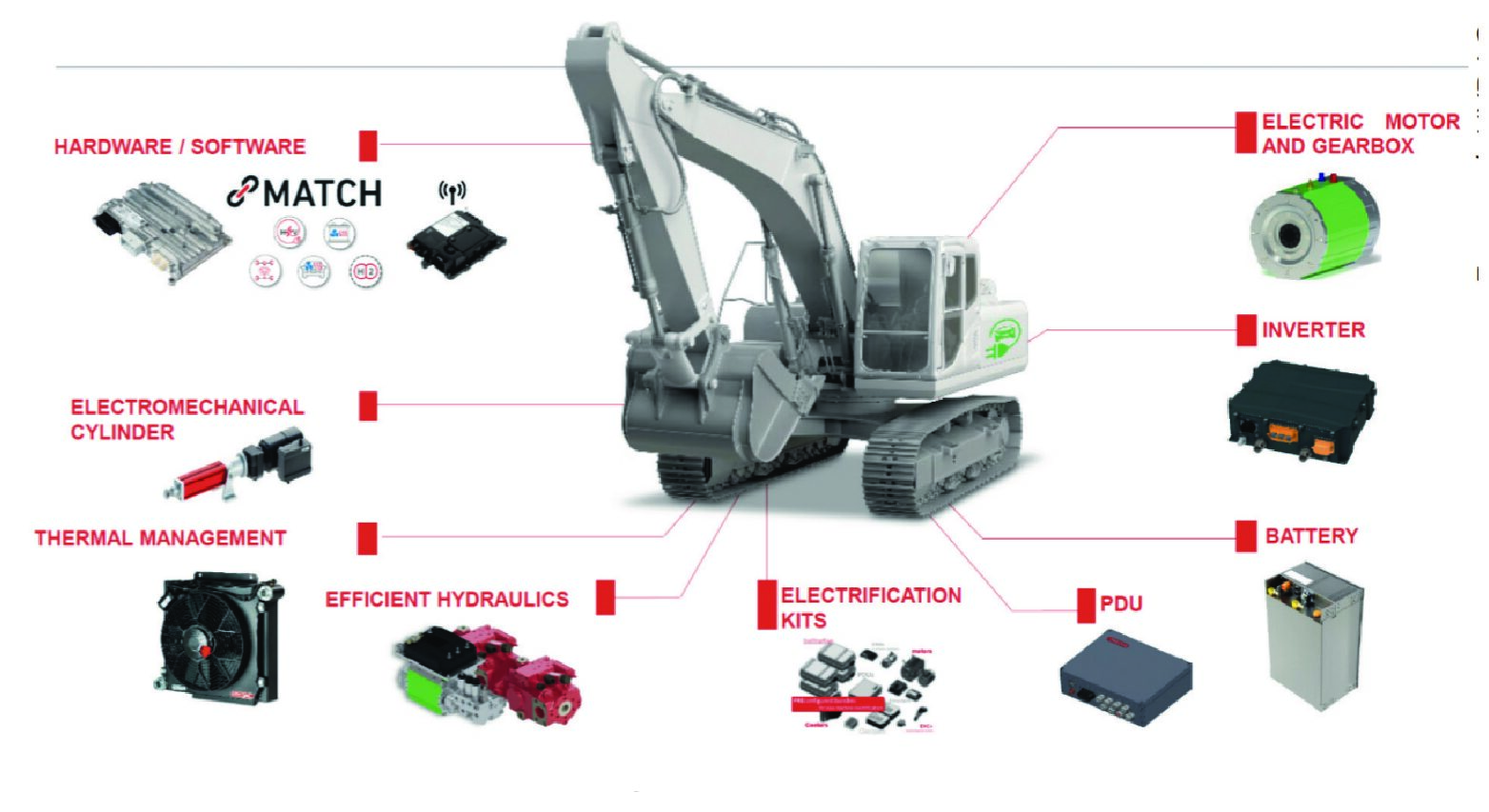
– One reason for these new investments is exactly what I mentioned before: if electrification is to be carried out efficiently, you need a holistic view right from the beginning and need to bring in all the different functions. For us, it then becomes natural to offer, as far as possible, many of the components, functions and subsystems that are needed. This means that we now have many accessories for electrified systems, such as battery solutions, thermal management, electric drivetrains and solutions for electrifying and improving the energy efficiency of hydraulics, Fredrik Kjellgren says.
Subsystems are becoming more common
The fact that people now increasingly talk about different subsystems related to electrification is another trend that Fredrik Kjellgren and his colleagues have noticed.
– Previously, electrification solutions were packaged as one unit, an e-kit. Today it is more about several different subsystems and functions. Customers want help with different functions and not always only with components. Another difference compared with five years ago is that back then discussions mainly concerned battery cell type and price, whereas today they concern cell type, capacity and integration.
– Integrating a subsystem into the machine’s own software, and above all its service systems, is the key to making sure the customer chooses the right technology for the specific application. If they make the wrong choice, integration can become very costly and complex, Fredrik Kjellberg explains.
The increase in connectivity means that safety is an area in which customers are asking for guidance to a much greater extent. Cybersecurity is crucial both for functional safety and for secure operation. The EU is tightening rules through, among other things, NIS2, R155/R156, the Machinery Regulation, the Cyber Resilience Act and RED, all of which require protected communication, secure updates and compliance with safety standards.
Use AI only where it creates value
During HYDAC’s September event, themes such as modularity, integrated system design, safety and intelligence kept returning. One recurring insight was that the major challenges today are not only about hardware but also about orchestrating complex systems with AI, data-driven decisions and robust cybersecurity.
– When it comes to AI, there are already good examples on the market, such as autonomous agricultural robots and applications in the mining sector. More generally, AI applications today mostly concern assistive systems, smart cameras and advanced monitoring systems. The goal is to avoid downtime as far as possible, since that can be very costly.
HYDAC helps customers with AI implementation, something that is in demand to varying degrees.
– We can help our customers with what they need, depending on where they are in their development. The key is to understand where AI can create real value in the business. At the same time, AI today is where electrification was five years ago – everyone is curious about everything. What needs to be examined with AI applications and AI support is where they provide real practical benefit.
They do not see any particular sector as clearly ahead or behind when it comes to demand for AI functions.
– We have projects under way in all areas involving different AI applications. Development is moving extremely fast right now, driven by the global situation.
The competence shortage is worrying
In addition to the technical challenges involved in increasing electrification, Fredrik Kjellgren sees another major challenge.
– It concerns the availability of competence, which is in varying shortage around the country. Even our large companies are worried about the competence shortage, so it is easy to understand how difficult it can be for small and medium-sized companies. The large companies are trying to push educational providers to train more people in a number of areas, since many kinds of competence are needed throughout the electrification process.
At the same time, he notes that the industry is still gaining knowledge through those companies that were early to carry out electrification projects.
– They have accumulated a great deal of experience that other actors and sectors are benefiting from, which is very positive. Then there are also us and other suppliers who contribute through specialist expertise in many areas. As I said earlier, we are now used a great deal as a sounding board and advisory partner, primarily by small and medium-sized companies. Larger companies also use us as dialogue partners during development projects, but then they tend to come with more specific questions.
E-lab for e-mobility in Gagnef
As additional support for customers, HYDAC started a new production facility in Gagnef this spring. Among other things, it includes an E-lab for e-mobility, an initiative that does not only concern hydraulic systems but also serves as a technology centre that includes electrification, thermal management and software.
– With our knowledge and competence in e-mobility, we want to contribute to increased electrification of motor-driven work vehicles. There, as in the rest of our operations, it is about actively supporting customers in developing mobile vehicles for the future transition from fossil-based solutions to greener and more environmentally friendly alternatives, Fredrik Kjellgren concludes.


