


This is stated by Tomas Beäff, who today works as a global safety consultant focusing on the regulatory framework that governs how machines are built safely.
– At the beginning of my working life, I worked hands-on in industry with, among other things, hydraulics, both as a designer and as a repair technician. After a number of years, I switched and started at the Swedish Work Environment Authority. Once I got there, I became aware of laws and regulations that I had previously known nothing about, and I then became more and more interested in the regulatory framework.
He worked as an inspector for the authority for eight years, and during that period he also became involved in EU standardisation work as a Swedish representative and expert.
– In the end, I felt that I had built up enough knowledge to help companies with safety work on my own, and I started working as a consultant. At first my customers were mostly companies in Sweden, but later I also began helping Swedish companies at their factories abroad. After that I also got international customers all over the world, so there has been a fair amount of travelling, Tomas Beäff says with a smile.
The consultancy he founded, Machine & Processaftey Analysis, works with safety issues in most industrial areas such as mechanics, hydraulics, pneumatics, control systems, ATEX and electrical systems.
Protection for health and safety
When it comes to hydraulics, the most important standard is EN ISO 4413, a B-standard that governs what hydraulic systems must fulfil in order to comply with the Machinery Directive. Electrical equipment is often included as well, and EN 60204-1 on machine electrical equipment is an important standard to take into account, since it is harmonised with both the Machinery Directive and the Low Voltage Directive.
– That directive has two purposes: to harmonise the applicable requirements in order to achieve a high level of health and safety protection, and to ensure the free movement of machinery on the EU market.
Safe use of hydraulic systems requires a basic understanding and functioning communication between buyer and seller.
– EN ISO 4413 was developed to contribute to such understanding and communication, and also to document good examples from people with extensive experience in the field. Standards are very useful tools for anyone who wants to build safe systems.
CE marking within the EU
Another important part of safety work is CE marking, which is a product marking within the European Union showing that a product fulfils the necessary requirements regarding, among other things, environment, health and safety if it is to be sold on the European market.
– It shows that, according to the manufacturer’s assessment, the product fulfils the EU’s norms for safety, health and environmental protection. The marking is required for products from all over the world that are to be sold in the EU.
The same requirements also apply in countries that have agreements with the EU through the EEA agreement, such as Iceland, Liechtenstein, Norway and Switzerland. Through the EEA agreement, parts of the EU internal market are extended to Iceland, Liechtenstein and Norway.
Candidate countries, that is several European states not yet part of the Union but aiming to join in the future, are also covered by the same framework. There are nine candidate countries: Albania, Bosnia and Herzegovina, Georgia, Moldova, Montenegro, North Macedonia, Serbia, Turkey and Ukraine.
– For hydraulics that are to be included in machines, hydraulic power units are normally classified as partly completed machinery for incorporation according to the machinery rules, since the system is part of the whole and the manufacturer only declares its delivery against the rules applying to the system. Control cabinets that may be included in the delivery to the power unit must be CE marked with regard to EMC and electrical safety requirements by the cabinet builder or the power unit supplier. In addition, there are certain requirements on the design of cylinders, valves and other components that must comply with various component standards, Tomas Beäff explains.
Inadequate risk assessment is a common error
For CE marking, self-certification is usually sufficient, although in some cases, for particularly hazardous machines, third-party inspection by a notified body within the EU may also be required. An important part of safety work is risk assessment for the overall system as well as for each delivery, in order to ensure the correct safety level for personal safety and operational reliability.
– A common error is inadequate risk assessment, both in self-certification and in the use of different equipment. How to carry out a good risk analysis can be found in standards and in the regulations governing the manufacture and use of machines.
If a company is the final manufacturer or system integrator, Tomas Beäff recommends that procurement contracts include requirements for risk assessments and important standards from suppliers. That makes it easier to CE mark the complete system and also helps with future changes.
Other common errors
As a consultant for more than 30 years, he often helps manufacturers ensure that regulatory frameworks and relevant standards are applied and followed. He also supports companies during the CE marking process so that the manufacturer can assure the market that it has fulfilled the EU design rules and requirements in relevant directives and regulations. He also supports procurement and final checks such as FAT and SAT.
– The most common general errors that emerge when there are safety problems are shortcomings in the self-certification work for CE marking. This applies both to technical shortcomings and shortcomings in documentation.
When it comes to hydraulic systems, sizing problems are among the most common faults that are identified.
– The system has not been dimensioned correctly for the work it is intended to perform; it simply cannot manage what you want it to do. Other common faults are that the harmonised standards applicable to hydraulic systems have not been followed, that there are shortcomings in the marking of components and piping systems, and that, where safety-related parts of the control system are included, they do not have the required reliability, which normally means SIL classification or PL classification.
At the same time, he wants to stress that within hydraulics, there has still been major improvement from suppliers and manufacturers since these regulations were introduced, compared with how things used to be.
Missing marking can be serious
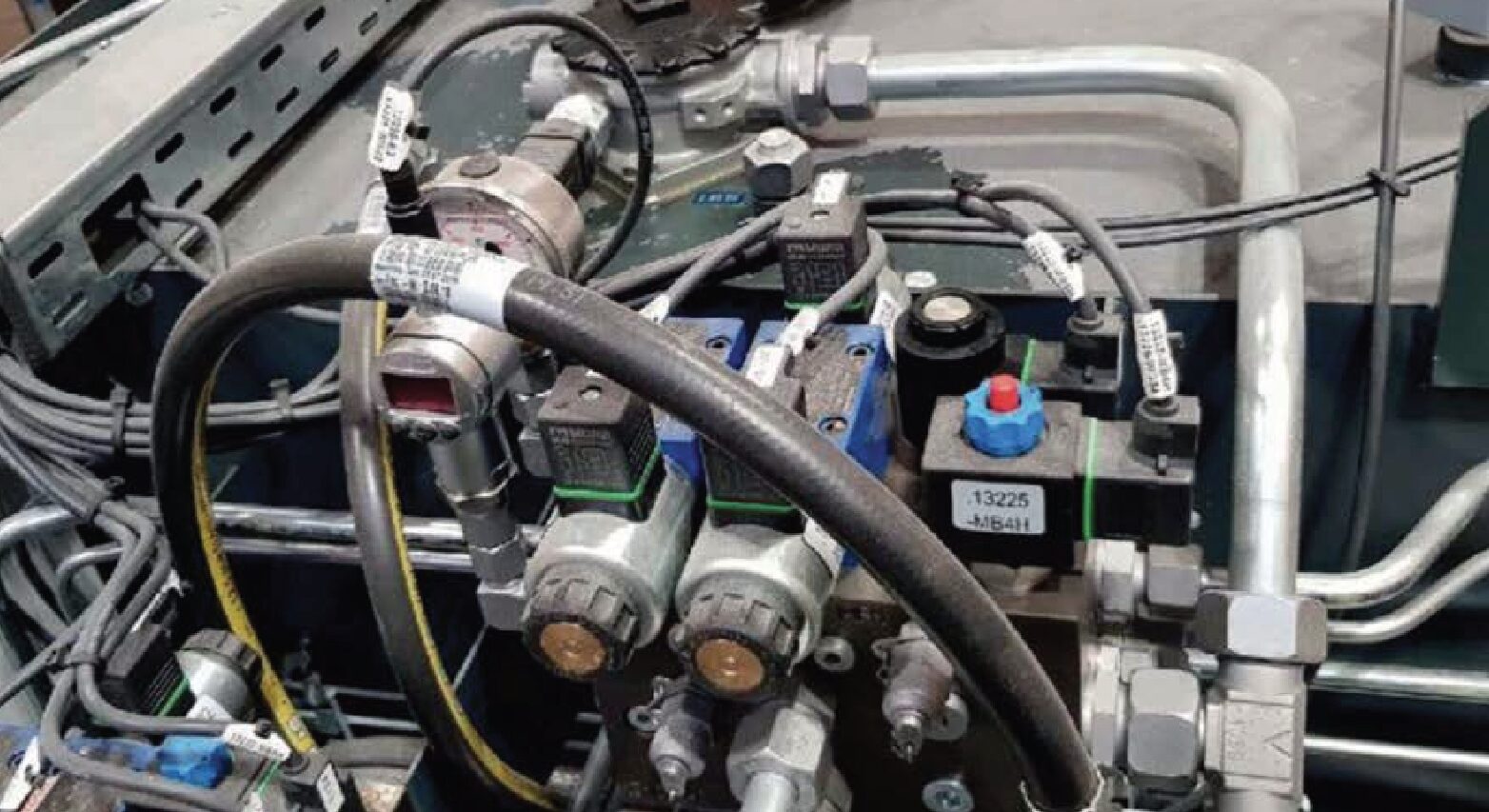
Shortcomings in marking can lead to accidents, create capacity problems, maintenance problems and also cause issues with supervisory authorities. As a general rule, all hydraulic components must be assigned a detail number and/or detail letter that is used in diagrams, lists and assembly drawings in order to identify the component on or next to the component itself.
– I discover such shortcomings when I help customers with inspection and supplier control before, for example, a CE marking process. If components are incorrectly marked, or not marked at all, this can lead to connection errors that in turn cause functional faults. It may also involve incorrect valve selection in certain applications.
Other risks concern health and working environment problems, for example if a leak occurs and oil sprays out. A narrow oil jet can also easily cut off one or more fingers if someone feels for leaks and is not paying attention.
– Basically, no hazard source should arise through sudden pressure shock, pressure increase, pressure loss, vacuum loss or vacuum failure. Pneumatic and hydraulic machine equipment must be designed so that the highest specified pressure cannot be exceeded in the circuits, for example through pressure-limiting devices. Nor should any fluid jet or sudden dangerous hose movement, such as hose whip, be able to occur through leakage or component failure.
Shortcomings in documentation are also common in hydraulics. This may involve missing certificates and instructions or language-related deficiencies.
– At the same time, I want to stress that many larger companies are good at creating safe workplaces with well-functioning systems. Smaller companies, however, may miss important parts of safety work because they do not always have resources available, which probably depends on both lack of knowledge and lack of resources.
Use standards as support
One recommendation Tomas Beäff gives is to make more use of standards as support during manufacturing, since they are based on extensive experience of what works and what does not.
– The most important standard for hydraulic systems is, as I already mentioned, EN ISO 4413. Then there is also SSG 3800, which clarifies certain parts of the EN ISO standard. It is intended to be used when selecting and procuring hydraulic equipment, with the aim of giving the user a safe hydraulic installation with high availability and low maintenance cost.
SSG 3800 specifies and clarifies the points in SS-EN ISO 4413:2010 that must be fulfilled by hydraulic equipment, or equipment in which hydraulics is included, in terms of function, safety, reliability, environment, energy efficiency and documentation.
– If you follow standards, you usually also get lower maintenance costs. If relevant documentation is missing, that in itself creates risks and also causes maintenance problems. It makes things harder for maintenance personnel if they do not know how to carry out, for example, a component replacement on a specific machine. The hydraulic circuit diagram is an important part of the documentation.
Hydraulic systems also usually contain an electric motor and pump, which means that electrical requirements must also be considered, most suitably by applying EN 60204-1 on machine electrical equipment.
– Accumulators are also often included in hydraulic power units in order to manage pressure shocks, and they act like a spring. That means the rules for pressure equipment become relevant. In such cases, gas-charged accumulators should, as far as possible, be depressurised automatically when energy to the machine is disconnected, and if that is not possible they should be fitted with devices for isolation, local depressurisation and pressure indication.
Similar safety work within pneumatics
Tomas Beäff also helps customers with safety work for pneumatic systems.
– The difference from hydraulics is that hydraulics works with greater forces and therefore higher risks. Otherwise, the safety aspects are similar.
The standard for pneumatics is ISO 4414, and in the same way as for hydraulics it specifies general rules and safety requirements for pneumatic systems and components in machines. The standard is harmonised against the Machinery Directive and deals with relevant requirements, except noise.
– In pneumatics, one of the most common shortcomings is incorrect valve selection for different applications. This leads in turn to functional faults and work environment risks. It may involve different safety-related control arrangements for, for example, valves, where verification of such circuits is often lacking when they affect safety-related functions.


