


Before the pressure equipment directive, PED, was introduced, an accumulator manufactured in one European country could not be used in another European country unless it also met that country’s pressure vessel rules. The directive has been updated over the years, and the currently applicable Swedish regulation is AFS 2023:5 on products – pressure-bearing devices.
– A major advantage of PED is that it removes technical trade barriers related to the supply of pressure equipment throughout Europe. PED is based on Essential Safety Requirements, ESR, which govern design, manufacturing, inspection and testing, says Sten-Ove Claesson, who has worked with quality and safety issues for many years, among other places at HYDAC, and now works as an independent consultant.
PED stands for Pressure Equipment Directive (2014/68/EU) and is a set of rules that apply within the EU to the manufacture of pressure-bearing equipment. The directive applies to equipment that has an overpressure greater than 0.5 bar. In Sweden, it is currently implemented through regulation AFS 2023:5.
Equipment that fulfils the safety requirements of the directive must bear a CE mark as proof that it meets the requirements in PED.
The equipment covered by the requirements includes:
• Pressure vessels
• Safety devices
• Industrial piping
• Pressure accessories
Under PED, the manufacturer is fully responsible for ensuring that its own products comply where they fall within the scope of PED. Compliance is demonstrated by CE marking and by a Certificate of Conformity from the manufacturer.
Inspections to avoid explosions
Recurring third-party inspections are carried out with the aim of ensuring that a pressure vessel does not explode.
– In the case of accumulators in hydraulics, the issue is to protect them from overpressure. In practice, this is done by installing a safety valve, or a rupture disc, close to the accumulator connected to the hydraulic system. Recurring inspections are also performed to detect fatigue damage and other physical damage to the vessel.
Threshold values for inspection requirements
In an accumulator there are two group 2a fluids, gas and hydraulic fluid, separated by, for example, a diaphragm or a rubber bladder.
– The fact that the accumulator contains gas, usually nitrogen, is the reason it falls under the pressure vessel directive. Gas is explosive when it expands rapidly after having been compressed, which can lead to explosions if sufficient safety components are not in place, Sten-Ove Claesson explains.
He further notes that there are threshold values for when an accumulator must be inspected.
– You multiply the pressure in bar by the volume in litres for the accumulator. If the value exceeds 1000 bar-litre, inspection is required according to the applicable inspection rules. The criteria for how inspections are to be carried out are covered in AFS 2023:11 on work equipment and personal protective equipment – safe use.
Missed inspections are a common problem
Over the years he has worked with pressure vessel issues in the industry, Sten-Ove Claesson says that one of the most common faults he has seen is that companies have missed the inspections.
– There may be several reasons for missed inspections, but one has to understand that this means exposing employees to a certain degree of risk, and fines are also imposed if the omissions are discovered.
Third-party inspection according to AFS 2023:11 only applies to industrial applications. On the mobile side, the same type of rules for accumulator inspection does not exist.
– That is somewhat strange, because although many accumulators in mobile machines are small and do not exceed the threshold value of 1000 bar-litre, there are also some larger ones. For example, dampers on the lifting arms of wheel loaders are definitely larger, but they still do not need to be inspected by third-party bodies.
Discussions are currently taking place about a stricter interpretation of inspections
Although PED has been updated over the years, there have in fact been no major changes in the rules for accumulator systems, which are separate systems docked to a hydraulic system. Only certain clarifications have been added.
– What has changed recently, however, is that some independent inspection bodies have started interpreting the rules differently. A discussion is currently taking place between the hydraulics industry through SFMA, SSG, which represents Swedish paper and steel industry, and SWETIC, an industry organisation to which some of the inspection bodies belong, regarding a new stricter interpretation they want to introduce.
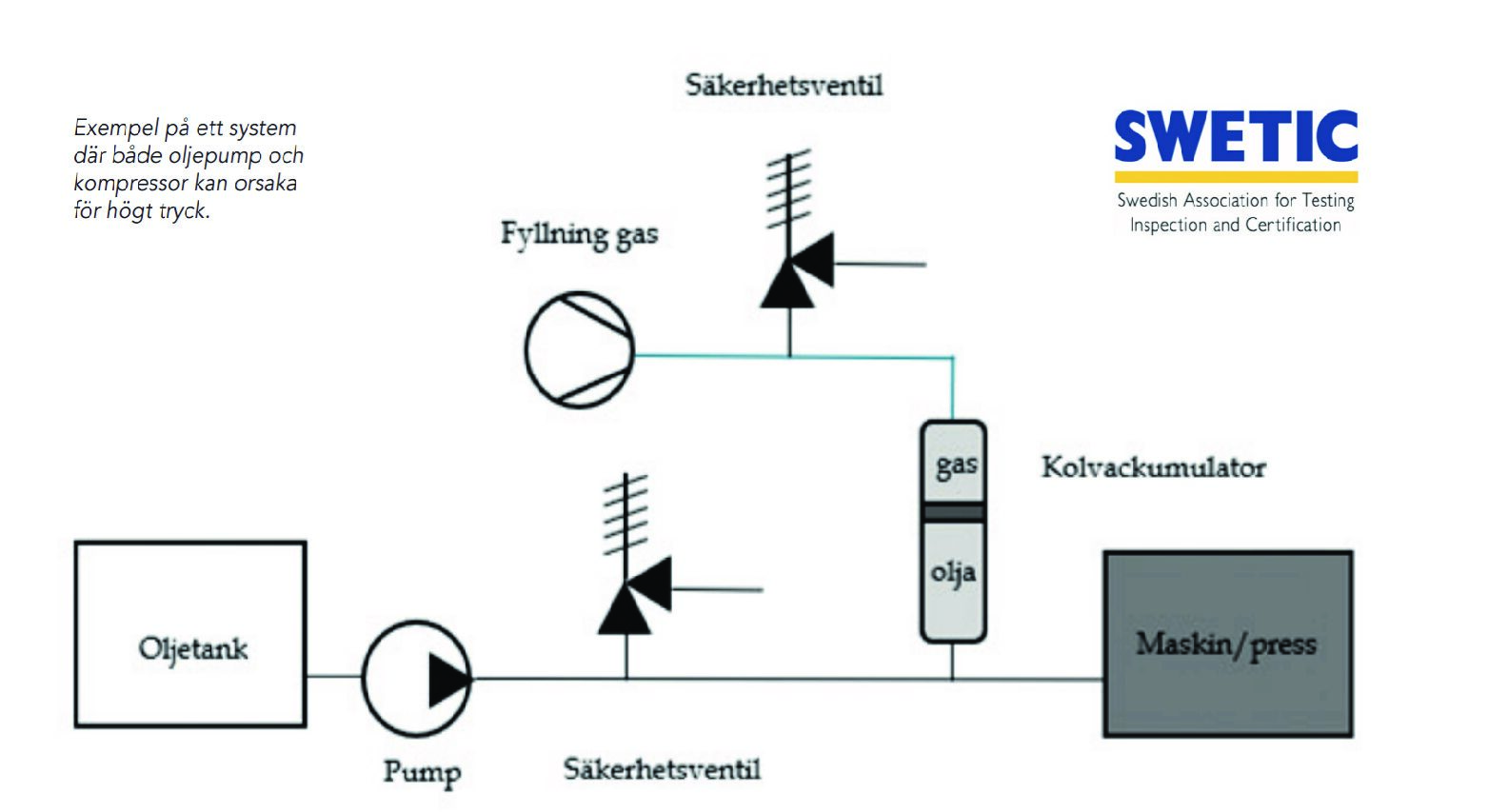
This concerns, among other things, their opinion that an additional safety valve is required to ensure the safety of the accumulator, and that it should be placed on the hydraulic system itself and also sealed at a certain level.
– Those of us who work with hydraulics know that such a sealed valve would make maintenance work in hydraulic systems significantly more difficult, while at the same time it could negatively affect functionality. That makes us wonder what grounds they have for this reinterpretation. It definitely does not have to do with any major accidents involving accumulators that could have been prevented by such a sealed safety valve, so why introduce this stricter interpretation? The same interpretation is not applied in other EU countries where PED is valid.
Could complicate things for the hydraulics industry
When inspections were introduced in 2006, a major investigation was carried out in Sweden in which, among others, the Swedish Work Environment Authority, SWETIC, Swedish industry and the hydraulics sector participated.
– They reached the interpretations of the inspection requirements that have been used up to now, and there has been no serious incident during all these years that would justify a stricter interpretation. One problem for us in the industry is that there are different internal interpretations down to the individual level within the accredited inspection companies. That would mean different interpretations of which inspections are needed for accumulators if SWETIC formally adopts its stricter interpretation. Such a situation would clearly be unfortunate both for the credibility of the inspection bodies and for industrial companies ordering inspections.
SWETIC has circulated a sketch showing where it believes the new sealed safety valve should be placed, and from the hydraulics side, SFMA and SSG are now discussing the issue with SWETIC, but so far have not received much response.
The sketch clearly shows that they do not understand how an accumulator system is connected to a hydraulic system. No compressor, actually a gas booster with its own safety equipment, is connected permanently to the system; it is connected only when needed. Most often, accumulators are filled via gas cylinders that are removed from the installation after gas filling. Safety equipment is mounted in adapters directly connected to the accumulator, and direct mounting of rupture discs in the accumulator vessel itself also occurs in piston accumulators.
– The proposed changes to the inspections would lead to costly modifications and rebuilds for Swedish industry, as well as more time spent during recurring inspections. It is difficult to see any serious motive for these changes when it is not really clear how the systems would become safer.
If one looks at all directives involving inspections and certificates, such as the Machinery Directive and the Pressure Equipment Directive, which are closest to our sector, their purpose is clearly to make things safer in terms of personal safety. They are meant to guide an interaction between machine builders and users so that people can work in as safe an environment as possible. They are not there to create jobs for companies.
– We would like to sit down and have a constructive dialogue with the inspection bodies in order to build understanding of the problems such an interpretation would entail. Within SWETIC there is no one with specific knowledge of hydraulic systems, which means that those of us who know the systems need to explain certain fundamental functions and try to find a common way forward regarding interpretations and function.


